RISC-V: Difference between revisions
No edit summary |
|||
| Line 1: | Line 1: | ||
[https://github.com/ucb-bar/riscv-sodor/blob/master/src/common/instructions.scala Instructions in binary] |
[https://github.com/ucb-bar/riscv-sodor/blob/master/src/common/instructions.scala Instructions in binary] |
||
[http://www.slideshare.net/mdecky/porting-helenos-to-riscv Porting HelenOS to RISC-V] |
|||
==Minimum Sized ISA== |
==Minimum Sized ISA== |
||
Revision as of 11:02, 2 November 2016
Minimum Sized ISA
Registers
- R32, 5-Bits specify register. 32 registers
- 4-bits will get you 16 (14)
- 3-Bits will get you 8 (6)
- 2 registers are fixed. R0 is always zero, XLEN-1 (last reg) is PC.
"For resource-constrained embedded applications, we have defined the RV32E subset, which only has 16 registers (Chapter 3)." - Spec (2.1p10)
"A further simplification is that the counter instructions (rdcycle[h],rdtime[h], rdinstret[h]) are no longer mandatory." - RV32E
Op Codes
- "All the 32-bit instructions in the base ISA have their lowest two bits set to 11" - Spec
xxxxxxxxxxxxxxaa 16-bit (aa != 11)
xxxxxxxxxxxbbb11 32-bit (bbb != 111)
xxxxxxxxxx011111 48-bit
xxxxxxxxx0111111 64-bit
xnnnxxxxx1111111 (80+16*nnn)-bit, nnn != 111
x111xxxxx1111111 Reserved for ≥192-bits
"In the base ISA, there are four core instruction formats (R/I/S/U), as shown in Figure 2.2. All are a fixed 32 bits in length and must be aligned on a four-byte boundary in memory. An instruction address misaligned exception is generated on a taken branch or unconditional jump if the target address is not four-byte aligned." - Spec (2.2)

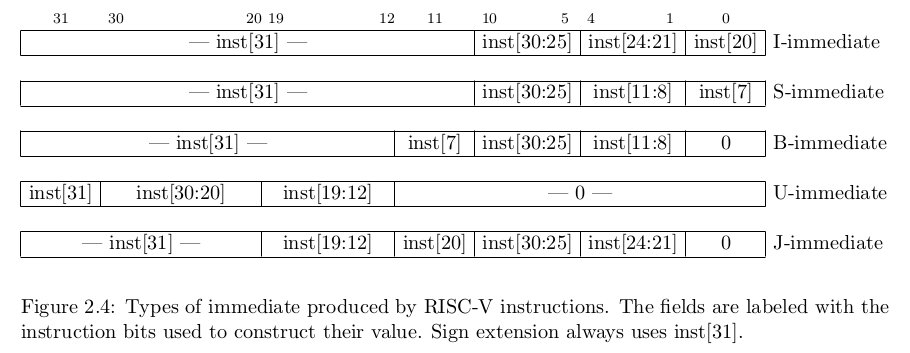
Immediate Encoding
"There are a further two variants of the instruction formats (SB/UJ) based on the handling of immediates" - Spec 2.3
"The only difference between the S and SB formats is that the 12-bit immediate field is used to encode branch offsets in multiples of 2 in the SB format. Instead of shifting all bits in the instruction- encoded immediate left by one in hardware as is conventionally done, the middle bits (imm[10:1]) and sign bit stay in fixed positions, while the lowest bit in S format (inst[7]) encodes a high-order bit in SB format."
"Similarly, the only difference between the U and UJ formats is that the 20-bit immediate is shifted left by 12 bits to form U immediates and by 1 bit to form J immediates. The location of instruction bits in the U and UJ format immediates is chosen to maximize overlap with the other formats and with each other."
"Integer computational instructions are either encoded as register-immediate operations using the I-type format or as register-register operations using the R-type format."
Instructions
- ADDI adds the sign-extended 12-bit immediate to register rs1. ADDI rd, rs1, 0 is used to implement the MV
rd, rs1 assembler pseudo-instruction.